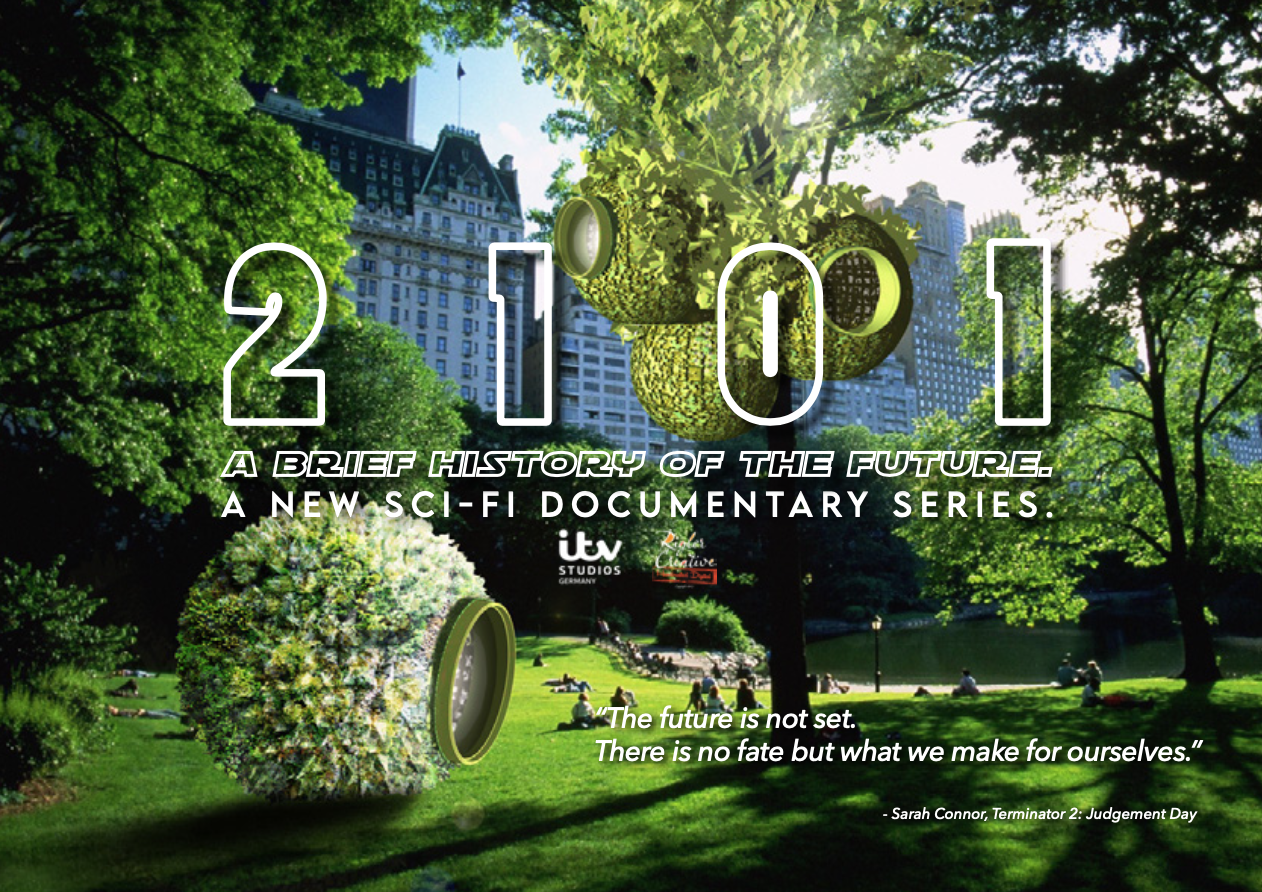
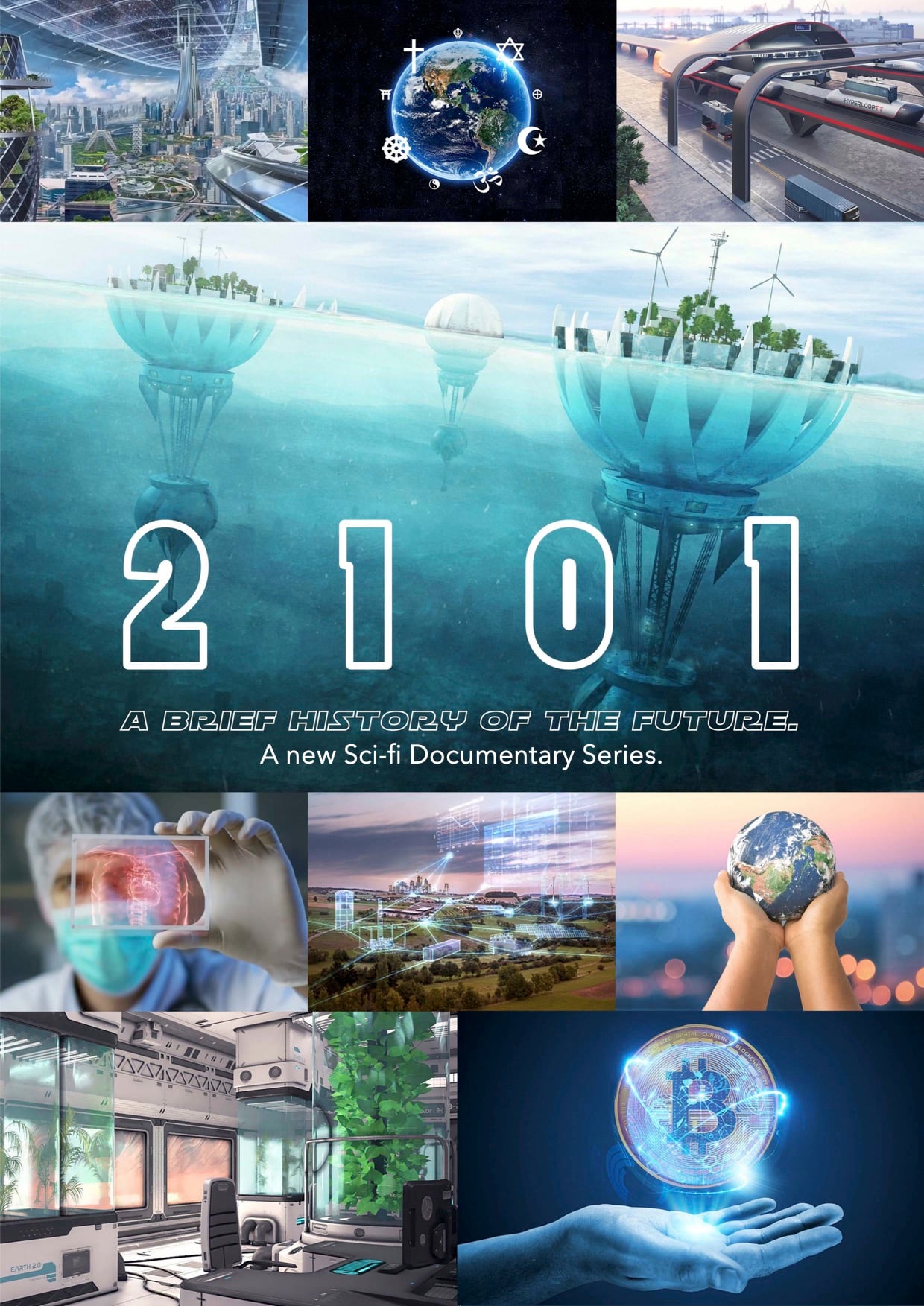



2101: A Brief History of the Future, ITV Studios.
Development assignment from ITV Studios to create a multi-part hybrid / narrative / non-fiction TV series about the future of humanity.
"2101" faces the challenges of today by choosing a route of die-hard optimism for the future, a path that takes responsibility and creates solutions, starting right now. That’s not to say we haven’t consumed dystopian stories of the future as much as the next sci-fi nerd. We simply doubt that more storytelling from the cliff-edge of the apocalypse is what humanity needs most right now.
Therefore, and in the spirit of the many great visionaries of the past and present, we choose to have faith and roll up our sleeves. There are plenty of reasons to be scared. But there are more reasons not to. The good news is that we can take action, right now. "2101: A Brief History of the Future" is based on compelling scientific premises and their inevitable effect on humanity.
By the year 2101, more than eleven billion humans will inhabit the earth.
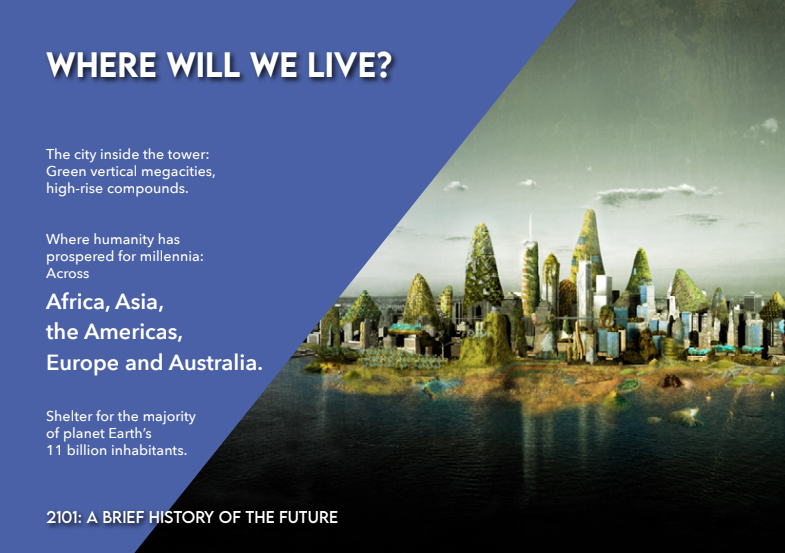
Close to ninety percent of us will live in urban centers.
200 years ago, the global population was one billion people, only three percent of whom were city dwellers.
"2101" communicates a strong message of individual self-responsibility. After all, “The Future” is not just a towering inevitability that arises from the ether. On the contrary, the future is the result of an infinite chain of events that we, humankind, shape actively and individually at every moment – and with the very survival of our species at stake.
If all goes well—and if we do our part to make it so—Homo sapiens in the year 2101 will have achieved a deeper understanding of our collective and individual role and thus our duty: To create a future we’d all like to live in.
Together we build our future based on the realizations and discoveries both from ancient times and moments ago. It doesn’t matter whether we as individuals are actually aware of the dynamics of cause and effect. Ignorance is NOT Bliss: We cannot escape our responsibilities by remaining ignorant of the results of our thoughts, words, and actions.
When asked what he might say to all of humanity if given the platform to do so, legendary sci-fi author Arthur C. Clarke replied, “The best advice I think was given by Douglas Adams: ‘Don’t panic.’
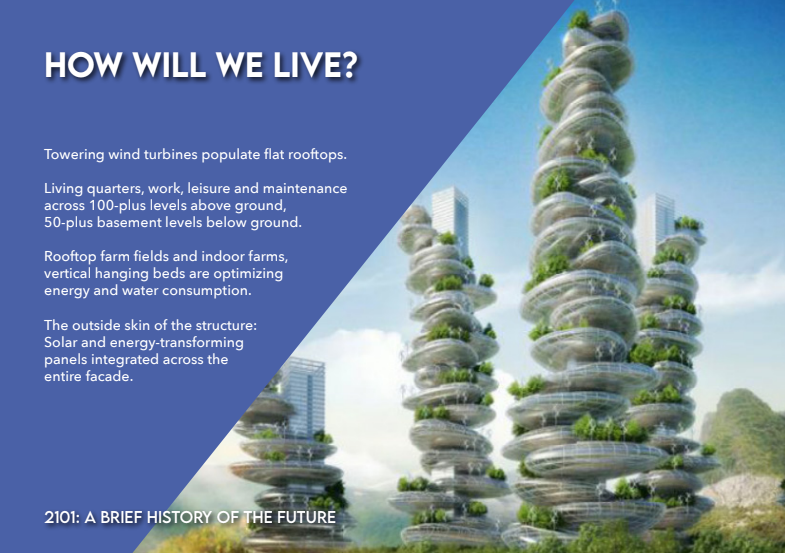
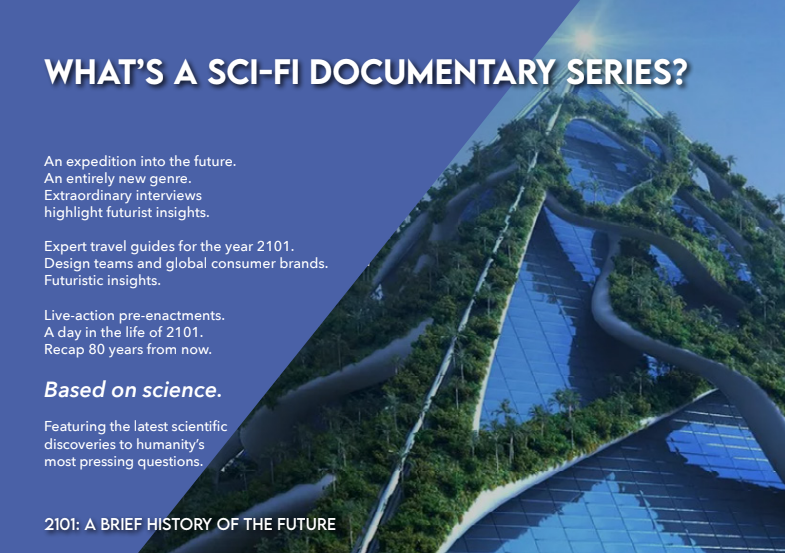
Each episode embarks on an expedition into the future of Homo sapiens, 80 years from now. Think of it as reverse archaeology, excavating the future instead of the past. Future-minded experts and popular public figures take viewers by the hand and, like inspired tour guides, lead them through times and places that exist in the world of the future, including those megacities that ninety percent of us will be living in.
Current global challenges such as climate change, overpopulation, urbanism, public health, and international conflicts are motivating forces for the visionary solutions that 2101 brings to life on the screen.
The big questions our species asks have remained fundamentally unchanged since the last ice age. The search for food, warmth, water, community, and the meaning of life and death have defined the human cycle of life since prehistoric times. As has the inevitable peek into the star-filled night sky with the many mysteries and answers it holds.
For the past 150 years, new technologies and scientific discoveries have radically changed the human experience, from the dawn of the industrial age through the atomic to the space age and the current digital era. The future is coming in fast. Some would say it’s already here.
Today’s questions don’t seem to be entirely different: How to secure a sustainable environment for everyone, safe and fair living conditions, establish governments and legislature beyond autocracy, tolerance beyond our own cultural traditions, and generally find a compassionate attitude towards our fellow Sapiens. It is up to each and every one of us to imagine and contribute to the solutions required in the coming eighty years.
For this purpose, 2101 seeks to assemble a great council of wisdom: Nobel Prize laureates, historians, philosophers, authors, artists, performers, politicians, physicists, CEOs, economists, MDs, legal experts, heads of state, biologists, chemists, farmers, indigenous elders, futurists, technocrats, astronauts, architects, athletes, and many more.
One of the topics that 2101’s council of experts and visionaries will explore is AI, including the sudden and widespread availability of generative AI that has set off a veritable storm of legal and ethical dilemmas. But questions of copyright and authorship are not the only AI issues at the center of our research.
Recently leaked studies from Bing’s and Google’s top-secret AI programs published transcripts of deeply personal conversations between AI chatbots—whose emotional understanding is believed to be on the level of a 10-year-old—and their human coach/ programmer. Particularly disturbing was the chatbot’s casual desire to be perceived and accepted as a sentient “person, just like you.”
The dilemma around AI and then-unknown technologies was already a driving force some 50 years ago, as seen in the seminal 1968 classic 2001—A Space Odyssey. In shaping their version of the future, Stanley Kubrick and Arthur C. Clarke managed to collaborate with the defining scientists, designers, and corporate brands of their era. This collaboration included gaining access to the construction plans for the Apollo program BEFORE it launched to the moon, thereby influencing, in turn, the most successful space program on the planet to date.
2101 also takes a close look at medicine and radical new disciplines like transhumanism and synthetic biology, which is another example of science fiction foreshadowing scientific reality. In Ridley Scott’s 1982 sci-fi thriller Blade Runner, identifying and chasing biosynthetic androids on the run was a key storyline, thereby intuiting and anticipating the conflicts around transhumanism and bio-synthesis that have already taken form in today’s world.